
Reputation management rules during the pandemic
- Home
- Creation
Pain of Profound Change
Throughout the world over the past few decades, we have become used to experiencing constant change. This has been particularly the case in Ukraine which is navigating a unique and challenging path towards an unknown destiny. The world has been wrestling with technological revolution, shifts in social norms, the blurring of identity and doubts as to the expediency of maintaining traditional social institutions, but the emergence of the COVID-19 pandemic in 2020 brought about a widespread reassessment of these issues and priorities. The pandemic has caused profound economic dislocation and we must consider its impact on all areas of life. Further, the dramatic effect it has had on humanity has brought the notion of sheer survival to the fore and raised the question of what must change in our day-to-day activities, relationships, and social interaction if life itself is at stake.
Suddenly, the process of digitisation has accelerated as a result both of necessity and compulsion. Those who had previously not been particularly interested in digital services, due to prejudice or age, began actively to utilise such services under the pressure of external circumstances. Furthermore, a significant proportion of consumers of goods and services has become poorer, more prudent and more uncertain about their future.
Of course, statesmen who were suddenly confronted with intense responsibility on an enormous scale were at first discombobulated and unsure how to respond, but it was not long before many of them found in the unprecedented global crisis an opportunity to blame the consequences of their prior mismanagement and abuse of power on COVID-19. In most cases this created an opportunity to continue to abuse their positions even more actively, while public attention was focused on the pandemic. However, business structures, as suppliers of goods and services, employers, taxpayers, and socially responsible corporate citizens, have had no right to fall into depression like mere mortals or to philosophise like statesmen. After all, while business is about money and ways to make money by anticipating or generating the needs of a target audience and then satisfying them, it also entails responsibility towards beneficiaries, employees, consumers etc. In fact, business provided a thread of normality in human activity that was otherwise being torn apart by the pandemic. This was in part due to COVID-19 CSR programs but, above all else, was the result of a cold-blooded desire to continue money-making activities regardless of the situation. This was achieved through rebuilding and modifying business processes and business models, rapidly implementing digitisation, and experimenting with new tools. This reformatting affected all management subsystems and functions including, of course, corporate reputation management.
Life Trends are Reputation Management Trends
Reputation is very closely related to day-to-day realities. No matter how eloquently the storytellers from PR promise to turn, with ease, a mouse into a hedgehog, any reputation structures and their representation in the information space are based upon practical actions, product quality, the qualifications of personnel, social and environmental projects and, of course, the skeletons in the cupboard. However, because an ordinary outsider rarely perceives the objective basis of their subjective perception, a company that systematically and diligently cares about its reputation can convey an image in the eyes of members of the public (who are not particularly attentive to details) that is very different from the basic character of the business. A strong positive media presence creates a smokescreen effect, so that the skeletons in the cupboard are almost invisible behind a dense wall of satisfied stakeholders. Normally, the real situation might only become obvious in the case of a successful information attack by detractors or miscalculations made by the company if it did not have time to stop the reputational risk at its source and allowed the consequences to spill out. However, the black swan of a global civilizational crisis has dispelled illusions and torn off the masks of everyone without exception. Therefore, current trends in reputation management are closely related to the direction of change in public life and social relations.
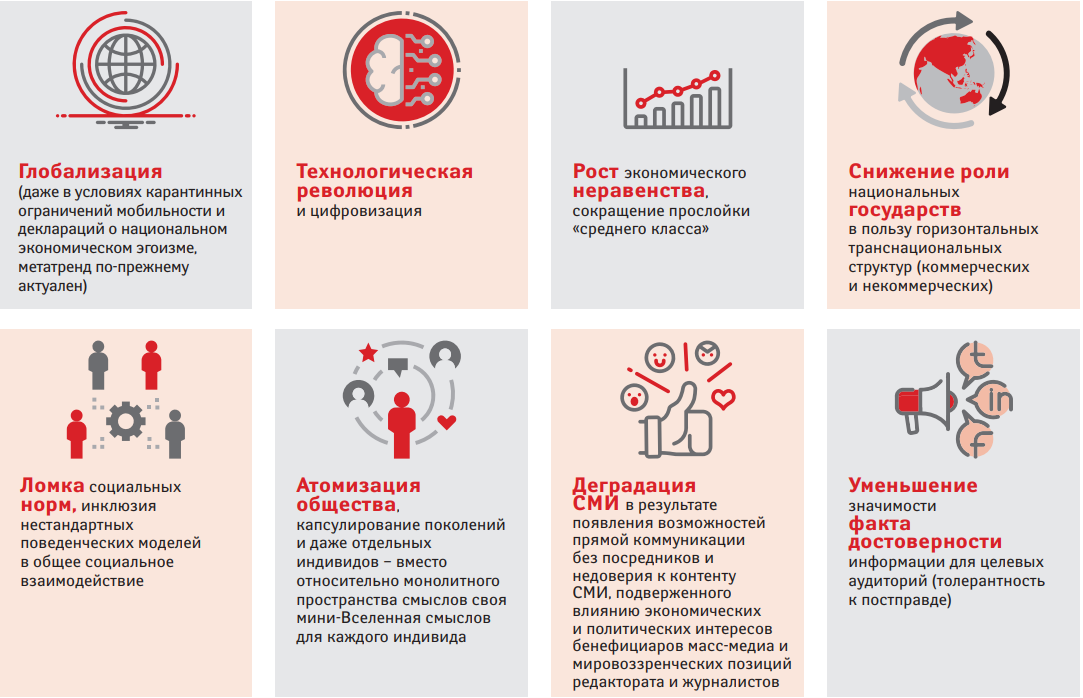
Even before the pandemic, attention was being paid to the main global metatrends in corporate reputation management over the last decade. Additionally, pandenomics forces us to consider objective economic, social, and psychological changes and take them into account when working on a company’s reputational strategy.
Globalization remains relevant even in conditions of quarantine restrictions and declarations of national economic self-interest
Technological revolution and digitalization
Growth of economic inequality and a reduction of the middle-class
Reduction of the role of nation states in favour of horizontal transnational structures (commercial and non-commercial)
Fracturing of social norms and the inclusion of non-standard behavioural patterns in general social interaction
Atomization of society, not only inter-generational but also between individuals – traditional monolithic understanding breaks down and everyone has their own miniature universe of meaning
Degradation of mass media due to opportunities for direct communication without intermediaries and distrust of mass media content (which expresses the vested economic and political interests of its beneficiaries and the worldview of editors and journalists)
Reduced emphasis on the reliability of information for target audiences (post-truth tolerance)
Recommendations for organising reputation management during the pandemic
|
Economic and social phenomena and processes |
Behaviour change |
Recommended reflection in the company’s reputational strategy |
|
A. Key target audiences |
||
|
1. Drop in living standards and purchasing power; deferred demand |
Economising (in most cases); reduction in impulsive consumption; lower susceptibility to brand promotions |
Empathy with and willingness to understand your target audiences and offer solutions that will make their lives easier |
|
2. Decrease in social activity (lockdown, remote work, lack of personal communication, restriction of mobility) |
Little interest in serious online events; replacement of enjoyable real-world experiences with online substitutes; a need for going out safely |
Online activities organized along the lines of real ones; hybrid events; a tone that creates the feeling that, “life goes on, and there is no apocalypse” |
|
3. Information overload (remote work overtime, additional household burdens and psychological impact of home office conditions); increased attention to alarming pandemic news |
Psychological instability; need to distract from routine and problems (escapism); fatigue of uncertainty; frustration; susceptibility to psycho- viruses |
Selective and concise communication with respect and without intrusiveness; calm and uplifting activities that generate an optimistic view of the world and lift the spirits |
|
4. Distrust of official information and traditional media; decrease in the influence of traditional media |
Exponential growth of interest in social media; greater willingness to receive information first hand, i.e. directly from companies and brands |
Development and promotion of own media to control key messaging related to reputation strategy rather than dependence on ineffective intermediaries |
| 5. Search for new types of activities capable of correcting the economic situation or psychological state | Change in types of activities; implementation of creative, social, and entrepreneurial initiatives previously postponed for one reason or another | Support for such initiatives: at the very least involving communication activities, but at best incorporating relevant projects into the company's ecosystem |
|
B. Business activity |
||
| 1. Quarantine restrictions on operational activities | Change of business processes; implementation of online solutions | Systematically informing stakeholders about changes and their positive effects |
| 2. COVID-19 CSR programs as a must-have element in corporate ESG practice | Need to develop such programs that are socially effective, provide public resonance, and are financially feasible for the company | Thorough study of each COVID-19 CSR activity; checking for hidden sources of reputational risk; reasonable and weighted informational support |
| 3. Narrowing of financial opportunities for implementation of development projects | Temptation to save on PR projects | Pragmatic approach to budgeting; presence of ‘protected’ items in the PR budget |
| 4. Improving the image of a business in the eyes of the public by showing its efforts to combat the pandemic (i.e. big business as a stable employer in the face of rising unemployment) | Reducing pressure from the media, which has recently been generally biased against business activities, especially big business | A chance to improve the positive visibility of the brand provided media relations in the company are properly organised |
| 5. Increasing importance of working with the internal public (employees) and understanding their motivation | Special attention to internal communications | Implementation of motivational reputation projects; creation of a workspace or platform for team communication; upholding the integrity of the company’s goals and values |
We could write articles and give lectures about every element in this table, but that is a matter for the future. For now it would suffice simply to consider those entities that scored highest in our Corporate Reputation Management Quality Rating and to study their reputation management systems, view case studies, and assess their methodologies in the context both of the market situation in their respective industries and of the general situation in the country. Our ‘Reputation ACTIVists’ are worthy of emulation because even if they do not completely follow the suggested pandemic rules of reputation management, they still take them into account in many respects. Unfortunately, the pandemic will not end tomorrow, and the vaccine is not a panacea, so the current upheaval to our way of life may continue for a long time, possibly even forever. Turbulence and uncertainty remain in the external business environment and might even increase as recent trends are followed by new ones. Therefore, the coming year will compel the development of new and more advanced reputation management practices. Not all of them can be predicted today, but we will definitely evaluate their effectiveness and reward new heroes at the VIII National Corporate Reputation Management Quality Rating.
Reputation ACTIVists, 2021